
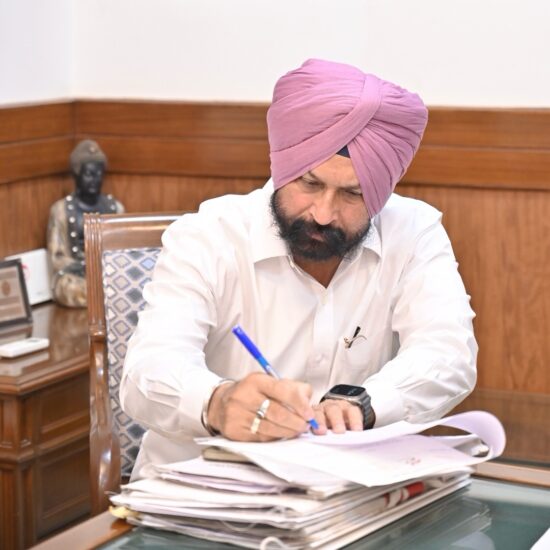
New Delhi: Senior Congress leader and retired ADGP Gurinder Singh Dhillon, IPS, has called upon the Union Government to turn the country’s extraordinary surplus liquidity into a strategic opportunity by directing capital towards defence production and critical national infrastructure.
Reacting to the Reserve Bank of India’s absorption of around ₹6.02 lakh crore of surplus liquidity, Dhillon argued that the money should not merely remain temporarily parked within the financial system at a time when India is facing persistent geopolitical uncertainty and growing strategic challenges.
“Don’t merely park liquidity. Convert liquidity into capability. Convert capital into national capacity,” Dhillon said, making a strong case for using available financial headroom to strengthen India’s long-term economic and strategic resilience.
According to Dhillon, the Government should consider planned borrowing and examine the possibility of a carefully calibrated additional borrowing of around ₹3 lakh crore, exclusively for strategic capital expenditure.
He stressed that such borrowing would be fundamentally different from borrowing to finance routine or recurring expenditure. If deployed towards productive assets and long-term national capacity, he argued, the expenditure could strengthen India’s defence preparedness, industrial base and infrastructure while creating durable economic value.
Dhillon suggested that any such strategic capital allocation should prioritise indigenous defence manufacturing, including programmes such as Tejas and AMCA, along with drones, counter-drone systems, missiles, ammunition and electronic-warfare capabilities.
He also called for greater investment in border infrastructure, railways, energy security and other critical national infrastructure, arguing that these areas have both immediate strategic importance and long-term economic benefits.
The former senior police officer’s argument comes against the backdrop of an increasingly uncertain geopolitical environment in which countries are seeking to strengthen domestic supply chains, defence production and strategic autonomy.
Dhillon maintained that India should use the current liquidity situation to accelerate this process rather than treating surplus liquidity simply as a temporary financial phenomenon.
“Let surplus liquidity build strategic capability and national capacity—not merely sit temporarily parked,” he said.
His proposal effectively links monetary liquidity with the broader question of India’s strategic preparedness, industrial self-reliance and infrastructure expansion.
The Congress leader’s intervention also raises a larger policy question: whether India’s available financial resources can be more aggressively channelled into productive capital formation at a time when defence modernisation, energy security, infrastructure development and domestic manufacturing are increasingly central to national security.
Dhillon’s message is clear: if capital is available, India should use it to build assets, capabilities and strategic strength for the future rather than allowing extraordinary liquidity to remain underutilised.