
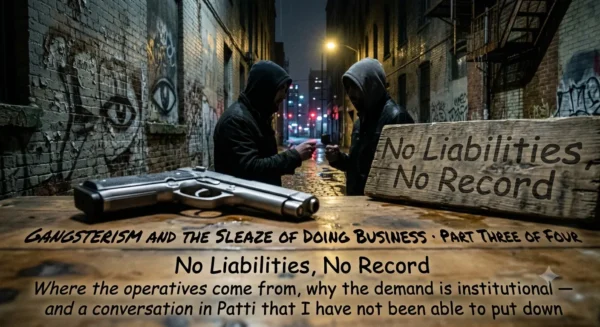
Yesterday I described the syndicate as an aggregator: a brand that owns nothing, employs nobody and buys discrete tasks from strangers. An aggregator needs two things to function. It needs labour, and it needs customers. Both are in ample supply, and the criminal world supplies neither.
What the aggregator wants in a man
He wants a young man with no criminal record, because a man with a record is on a list, is picked up on suspicion, is known to the SHO, and can be leaned on. He wants a man with no dependants and no assets, because such a man has nothing that can be taken from him and nothing that makes him traceable. He wants a man who can stand at a bus stop in Ludhiana or a chowk in west Delhi without a single passer-by looking twice — which means a man who dresses as everyone dresses, and above all who speaks the local language, because an accent is the oldest form of identification there is.
Punjab and Delhi now supply this profile in quantity, and from two directions.
There is the local young man: educated to a point, credentialed to a point, and employable at neither. I want to be careful here, because I have argued elsewhere against the lazy narrative that Punjab’s youth are collectively lost. The 2022 State survey found that 84.6 per cent of residents reported no substance use at all, and the opioid-dependent figure from the most rigorous survey available is 0.7 per cent of the population. Serious; not a pandemic. The same discipline applies here. We are not describing a generation. We are describing a margin — but a margin of a very large number is itself a very large number, and the syndicate does not need the generation. It needs a few thousand.
And there is the migrant young man, from eastern Uttar Pradesh and from Bihar, present in Punjab and in the National Capital Region in numbers that make him effectively invisible, and — the operational point — increasingly fluent enough in Punjabi and Haryanvi to pass. He carries no local antecedents. His name means nothing to the district crime record bureau. His family is eight hundred kilometres away and will be told nothing. If he is arrested he can be replaced from the same source within the week.
What connects both types is the telephone in his hand.
A young man in Mansa or in Mau now spends several hours a day watching a curated, algorithmically intensified exhibition of what money buys: the modified SUV, the gym physique, the imported pistol displayed as jewellery, the aeroplane window, the caption in Punjabi about respect and enemies. He is not merely idle. He is idle while being shown, continuously, at close range, in his own language, by people who look like him, what he is missing. This is not how poverty worked in my father’s generation, when the wealthy were geographically and socially remote and the comparison was to the next village. The comparison is now to Dubai, and it arrives every ninety seconds.
Shahzad Bhatti, the Pakistan-based figure whose network Indian agencies dismantled on 17 August 2026, understood this exactly. He built his following first as a Punjabi-language gangster-influencer, branding himself across Instagram handles ending in “333”, before — as the agencies allege — being folded into an ISI-directed structure. The recruitment did not begin with ideology. It began with followers. And then the ladder: young men paid small sums to paste posters and make threatening calls; screened for reliability; walked step by step toward reconnaissance, then weapons retrieval, and in some cases toward drone-delivered ordnance. Nobody was radicalised at the first step. Nobody needed to be. They were onboarded.
A conversation in Patti
I want to set down, with the caution it deserves, an account given to me directly, because it is the sort of thing that never reaches a crime statistic and rarely reaches print.
Some time ago, through an ex-serviceman friend, I spoke at length with a professional man in the Patti area of Tarn Taran district — a Jat Sikh of the locality, in practice for many years, whose clients come to him from across that stretch of the border belt. I am not naming him, and the reader will understand why. This is one man’s testimony, not a survey, and I offer it as such.
Extortion in that area, he said, is not an occasional outrage. It is a rising, routine and largely uncontested feature of doing any business at all. Anyone with an establishment of any visible sort — he instanced a small private school, a rice sheller, a commission agent, an arhtiya — is making payments for personal safety. Not for protection of stock, or of premises, but of his own person and family. The police, in his assessment, are simply not able to stop it. And it has reached past the shopkeeping classes altogether, to ordinary landowners with ten acres, and to retired public servants of the district, including medical men.
Then he told me the part I have not been able to put down since.
Once you are on their list, you do not come off it. They do not lose interest, they do not move on to an easier target, and they do not forget. And they demonstrate, rather than assert. What they demonstrate is that they know the movements of your children — when the school van comes, which turning it takes, at what hour it returns — and they are particular, he said, about your daughters. Nothing further needs to be said on the telephone. The information itself is the sentence, and it is delivered in the flat, administrative tone of a man reading out a schedule.
The most chilling of it was this. They will tell you, quite calmly, that at such-and-such an hour on such-and-such a day you went to the police station.
I wrote in the first part of this series, as an inference from the general logic of the trade, that the extortion demand carries an implicit clause no FIR can neutralise: we will know that you complained. Here is a man in a border tehsil of Tarn Taran telling me it is not an inference at all. It is a service they provide, in the form of a recital of your own movements, and its purpose is to establish that the one lawful avenue open to you has been placed under observation.
At which point going to the police is no longer merely futile. It has become an additional and separate risk, borne by you and demonstrably by your children, and the citizen has been manoeuvred into a position where his own State is the most dangerous institution he can approach.
Two further things he said have stayed with me. The first is that this did not happen even at the height of the militancy. That is a considerable statement, and I record it without embellishment. Patti is in the border belt of Tarn Taran; it saw the worst of those years at close quarters, and the people of that area do not use such comparisons loosely. Whatever else the men of the 1980s and 1990s were, they were not, in the main, running a subscription business against the local rice sheller.
The second is that nobody seems to know at whose behest the collectors are operating. Not the victims, not the neighbours, and, apparently, not with any consequence for the collectors.
Patti is not a prosperous tehsil. That the trade has found it worth working tells us how far down the income scale this economy now reaches, and how little it needs to find worth taking.
The court that could not recover
Now to the demand side, which has least to do with gangsters and is for that reason the most neglected.
Not the celebrity assassinations, which are rare and fascinate us out of all proportion to their frequency. I mean the ordinary, high-volume demand: the businessman who wants his money back, the partner squeezed out of a firm, the landlord with a tenant who will not vacate, the family in a property dispute in its fourteenth year.
These people are not criminals. Most have, at some point, done the lawful thing. They filed the suit. They obtained the decree. And then they discovered what every practitioner in this country knows and every citizen learns exactly once: that obtaining a decree and executing a decree are two entirely different enterprises, and that the second may outlast the plaintiff.
The figures are worse than most people outside the system imagine. According to National Judicial Data Grid data, a civil suit in India takes on average about 4.91 years to conclude — and the execution petition that follows adds roughly four years more. A litigant who wins waits close to a decade to receive what a court has already held to be his. In October 2025, in Periyammal v. Rajamani, the Supreme Court described the position as a travesty of justice, noting that 8.82 lakh execution petitions were then pending across the district judiciary despite a mandatory six-month disposal timeline laid down in its own earlier directions. By one account cited before the Court, nearly a third of all civil matters in the district courts are execution petitions.
To be fair, the Court has since moved with unusual energy. Its direction of 6 March 2025 produced the clearance of 3,38,685 petitions in six months. And on 25 May 2026 a Bench proposed dedicated District Execution Cells, asking the Union why the draft Commercial Courts Rules of 2021, whose Chapter XII contemplates precisely such cells, had not been notified in five years. That question deserves an answer.
A gangster offers what the civil justice system does not: speed, certainty and finality, for a percentage. He does not require documents. He does not adjourn. He charges more than a lawyer and delivers faster than a court, and the terrible thing is that for the aggrieved party this is frequently a rational choice.
I do not excuse it; I am describing it. And note that the failure operates at both ends of the same transaction. The man who cannot recover his money through the courts hires a gangster. The shopkeeper who is being extorted does not go to the courts either — as the Una jewellers did not — because he has correctly assessed that the system will not protect him and may expose him. The same institutional deficit produces the customer and the victim.
Any serious programme against gangsterism that does not include the execution of civil decrees, the timeline of commercial suits and the enforcement of arbitral awards is not a serious programme. It is a policing plan addressed to a justice problem.