
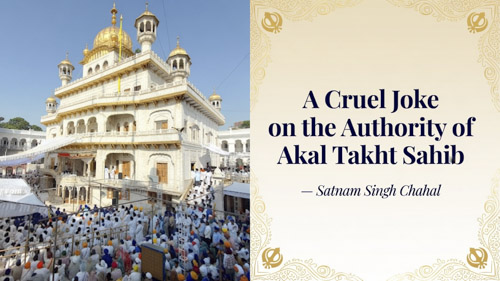
 For every Sikh, Akal Takht Sahib is not merely a historic monument or a religious institution. It is the supreme temporal authority of the Sikh Panth, established to uphold justice, protect Sikh principles, and provide guidance during moments of crisis. Throughout history, Sikhs have proudly declared that the directives issued from Akal Takht Sahib deserve respect and obedience. Yet today, a disturbing contradiction has become increasingly visible: many publicly profess complete faith in Akal Takht Sahib while privately searching for reasons, loopholes, and technicalities to avoid following its directives. This contradiction is not merely hypocrisy—it is a cruel joke on the authority of Akal Takht Sahib itself.
Whenever a difficult directive is issued, public declarations of respect are quickly followed by endless debates over interpretation, procedure, jurisdiction, timing, or technical objections. Suddenly, those who were proclaiming absolute devotion become constitutional experts, historians, legal analysts, and political strategists. Every possible excuse is explored—not to understand the directive better, but to avoid implementing it. Respect becomes symbolic while obedience becomes optional.
History reminds us that the strength of Akal Takht Sahib never rested on buildings or ceremonial gatherings. Its authority rested on the willingness of the Sikh community to accept difficult decisions, even when they demanded personal sacrifice or political inconvenience. The institution earned global respect because Sikhs considered its authority greater than personal ambition, party politics, or individual prestige. If every directive is now subjected to selective acceptance, the institution’s moral authority inevitably weakens.
The problem is not disagreement. Every institution can be discussed respectfully within the framework of Sikh traditions. The real danger begins when individuals publicly bow before Akal Takht Sahib while privately deciding which directives suit their interests and which can safely be ignored. Selective obedience is, in reality, a sophisticated form of disobedience. One cannot simultaneously claim complete submission and complete freedom to choose which decisions deserve implementation.
This growing culture sends a dangerous message to future generations. Young Sikhs observe respected leaders making solemn commitments before the Panth, only to spend weeks or months explaining why those commitments cannot actually be fulfilled. Such behavior teaches that public declarations are ceremonial while real decisions are governed by political calculations. Institutions lose credibility not only when they make mistakes, but when their own followers refuse to honour their authority.
No religious institution can survive if every directive becomes negotiable according to personal convenience. If every individual becomes the final judge of whether to comply, the very concept of collective authority disappears. Then Akal Takht Sahib risks becoming a symbol to be praised in speeches rather than an institution whose guidance carries practical meaning.
The Sikh Panth has repeatedly demonstrated throughout history that unity comes from shared respect for institutions rather than unquestioning loyalty to individuals. That principle remains just as relevant today. If there are concerns regarding any decision, they should be addressed through established Panthic processes with dignity, honesty, and transparency—not by making public promises of obedience while privately constructing arguments for non-compliance.
The question before the Sikh community is therefore simple and unavoidable. Do we genuinely believe that the authority of Akal Takht Sahib deserves to be honoured in both word and deed, or do we merely invoke its name when it serves our interests? Respect without obedience becomes symbolism. Commitment without action becomes performance. Public pledges followed by carefully crafted excuses diminish not only individual credibility but also the collective strength of the institution itself.
The Sikh Panth deserves better than symbolic reverence. It deserves sincerity. If we stand before Akal Takht Sahib and declare that we shall honour its authority, then our actions must reflect those words. Otherwise, every pledge of obedience followed by an excuse becomes another blow to the institution’s moral authority—and another cruel joke on one of Sikhism’s most revered institutions.
When the Authority of Akal Takht Sahib Was Above Personal Interest
The authority of Akal Takht Sahib was established by the Sixth Guru, Guru Hargobind Sahib, in 1606 as the supreme temporal seat of the Sikh community. From its very beginning, it represented the principle that Sikhs would not only live by spiritual values but would also collectively uphold justice, discipline, and responsibility in worldly affairs.
1606 – Foundation of Akal Takht Sahib
Guru Hargobind Sahib established Akal Takht Sahib directly opposite Sri Harmandir Sahib. The two institutions together symbolized the Sikh doctrine of Miri-Piri—the inseparable relationship between temporal responsibility and spiritual authority. Since then, Akal Takht Sahib has served as the highest institution for collective Sikh decisions.
The Eighteenth Century – Collective Decisions During Times of Persecution
During one of the darkest periods in Sikh history, when Sikhs faced relentless persecution under Mughal and Afghan rulers, Sikh leaders gathered at Akal Takht Sahib during the Sarbat Khalsa. Decisions taken there were accepted collectively despite enormous personal risks. Individual chiefs often put aside personal ambitions in favour of Panthic unity.
1765 – Sikh Confederacy and Panthic Unity
As Sikh Misls established control over large parts of Punjab, Akal Takht Sahib continued to serve as the moral and collective centre of the Sikh nation. Even powerful military leaders recognized that personal authority should not overshadow Panthic authority.
Nineteenth Century – Maharaja Ranjit Singh’s Humility
One of the most frequently cited examples of respect for Panthic authority is that Maharaja Ranjit Singh, despite ruling one of the strongest kingdoms in Asia, accepted religious discipline imposed by Sikh religious authorities. Whether in matters of personal conduct or public accountability, the ruler did not place himself above Sikh institutions. His example demonstrated that even the most powerful leader remained answerable to Panthic authority.
1920–1925 – The Gurdwara Reform Movement
Thousands of Sikhs sacrificed their lives and liberties to free Sikh gurdwaras from corrupt hereditary control. Their struggle was not for political power but to restore the authority and dignity of Sikh institutions, with Akal Takht Sahib serving as the central symbol of Panthic sovereignty.
1980s – A Time of Division and Turmoil
The turbulent years of the 1980s deeply affected Sikh institutions. Internal disagreements, political pressures, and violence tested the authority of Akal Takht Sahib. Many scholars and observers continue to debate the lessons of this period, but one point remains clear: whenever Panthic unity weakened, the community paid a heavy price.
Today – The Challenge of Selective Obedience
The greatest challenge facing the Sikh community today is not the absence of respect in words but inconsistency in action. Public figures routinely declare complete faith in Akal Takht Sahib. Yet when directives conflict with political interests, organizational loyalties, or personal ambitions, explanations and technical objections often replace compliance.
The issue is therefore larger than any one controversy or any one leader. The real question is whether the Sikh Panth will preserve the historic principle that no individual is greater than its highest institution. Throughout Sikh history, the authority of Akal Takht Sahib earned respect because Sikhs believed that collective discipline was essential for unity. If obedience becomes selective, the institution’s moral authority inevitably weakens.
History teaches a simple lesson: institutions remain strong only when their authority is respected consistently, not only when it is convenient. Every generation inherits the responsibility to protect that principle. If today’s Sikhs truly wish to honour the legacy of Guru Hargobind Sahib, the Sarbat Khalsa tradition, the Gurdwara Reform Movement, and the sacrifices of countless martyrs, then reverence for Akal Takht Sahib must be reflected not only in words spoken before the media, but also in actions taken when obedience demands sacrifice.
Disclaimer: This article and accompanying images are for informational and illustrative purposes only. Some visuals may be AI-generated or digitally enhanced and may not depict actual events or persons.Views expressed are based on publicly available information and analysis.