
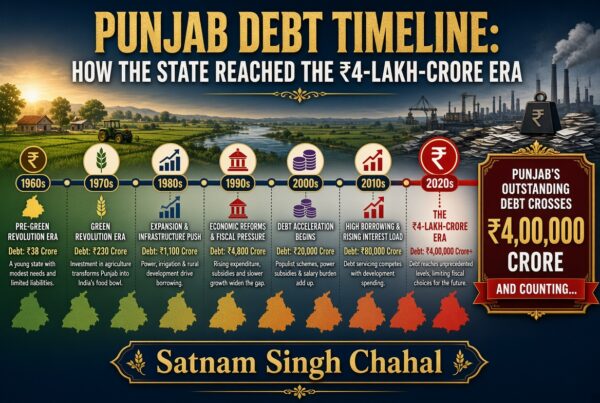
Punjab’s debt crisis did not develop overnight, nor can it be blamed entirely on one political party or one government. It is the result of several decades of borrowing, rising expenditure, subsidies, pensions, salaries, power-sector obligations, weak revenue growth and repeated fiscal deficits. But the speed with which the state’s liabilities have increased in recent years has made the issue impossible to ignore. Punjab has moved from a state whose debt was measured in tens of thousands of crores to one whose outstanding liabilities are now measured in more than ₹4 lakh crore.
The story goes back several decades. Punjab entered the post-Green Revolution period with a powerful agricultural economy, strong rural incomes and a reputation as one of India’s most prosperous states. However, the state gradually became heavily dependent on agriculture, government expenditure and subsidies while failing to develop sufficiently strong alternative engines of growth. Industrialisation slowed, new investment remained inadequate and the state’s revenue-generating capacity did not grow fast enough to match its expenditure commitments.
During the 1990s and early 2000s, Punjab’s financial pressures gradually became more visible. Free or subsidised electricity for agriculture, government salaries, pensions, welfare commitments and growing interest payments placed increasing pressure on the state budget. The problem was not simply that Punjab borrowed money. The larger problem was that the state was borrowing while its economic structure was becoming increasingly dependent on sectors that generated limited additional government revenue.
Between 2007 and 2012, Punjab continued to carry substantial fiscal pressures. The state remained agriculturally strong, but agriculture itself was becoming increasingly stressed. The traditional model of wheat and paddy cultivation was consuming enormous quantities of water while offering limited opportunities for diversification. At the same time, Punjab’s industrial sector was struggling to keep pace with states that were attracting large-scale private investment.Between 2012 and 2017, the debt problem became even more visible. Punjab continued to face pressure from subsidies, salaries, pensions and interest payments. The state’s liabilities kept increasing while its revenue base remained relatively weak. By the time the Congress government came to power in 2017, Punjab was already carrying a very substantial debt burden.
The Congress government therefore inherited a difficult financial situation. During this period, the government announced a farm-loan waiver and continued to finance the state’s existing commitments. The COVID-19 pandemic subsequently created additional financial pressure. Economic activity slowed, government revenues were affected and the demand for public expenditure increased. Punjab entered the pandemic with limited fiscal flexibility and emerged with an even more difficult financial position.When the Aam Aadmi Party government headed by Bhagwant Mann came to power in March 2022, it inherited a state already under significant financial pressure. The new government promised better financial management, stronger revenue collection, action against corruption and a new economic direction. However, the state’s borrowing continued, and the political battle over Punjab’s debt became increasingly intense.
The government argued that it had inherited a large debt burden and that borrowing was necessary to meet existing obligations and maintain government services. Opposition parties, meanwhile, accused the government of increasing the debt at an unsustainable pace. Both arguments have political value, but the underlying financial figures remain the more important issue. Punjab’s debt has continued to rise under successive governments.According to Punjab budget documents analysed by PRS, the state’s outstanding liabilities were equivalent to approximately 43.6 per cent of GSDP in 2022-23. The fiscal deficit was around 5 per cent of GSDP. This meant that Punjab was carrying liabilities approaching half of the value of its annual economic output while continuing to run substantial annual deficits.By 2023-24, Punjab’s outstanding liabilities had reached approximately ₹3.55 lakh crore, according to data cited in the NITI Aayog Fiscal Health Index analysis. The figure represented an increase of roughly 55 per cent over the approximately ₹2.29 lakh crore recorded in 2019-20. The state’s liabilities were equivalent to around 43.7 per cent of GSDP. This was a clear indication that the debt problem was no longer simply historical. The liabilities were continuing to expand.
The 2024-25 financial year brought another warning. Punjab’s outstanding liabilities remained around 43.6 per cent of GSDP, while the state’s actual fiscal deficit was around 4.7 per cent of GSDP, higher than the budget estimate. The revenue deficit was also significant. This distinction is important because a revenue deficit means the government is borrowing even while struggling to meet its recurring expenditure from its regular revenues.During 2025-26, Punjab crossed an important psychological and financial milestone. The state’s debt moved beyond the ₹4-lakh-crore level. By January 2026, reports indicated that Punjab had borrowed more than ₹20,000 crore since April 2025, taking its outstanding debt to approximately ₹4.03 lakh crore.The figure projected for March 31, 2026 was even higher. Punjab was expected to end the financial year with outstanding debt of approximately ₹4.17 lakh crore. This represented a substantial increase over the previous year’s level. The state had therefore entered what can fairly be described as the ₹4-lakh-crore era.
The 2026-27 Budget provides a more complicated picture. Punjab has projected outstanding liabilities at approximately 45.1 per cent of GSDP at the end of 2026-27. The government has also projected a fiscal deficit of approximately ₹39,971 crore, or 4.1 per cent of GSDP, while the revenue deficit is projected at around ₹21,955 crore, or 2.2 per cent of GSDP. These numbers suggest that the government is attempting to manage the debt-to-GSDP ratio, but the absolute level of debt remains extremely high.
The annual borrowing figures also demonstrate the scale of the problem. Punjab’s government is simultaneously borrowing new money and repaying existing debt. This is normal in public finance to some extent, but when new borrowing remains very high year after year, the state can enter a cycle in which it is effectively refinancing its accumulated obligations rather than reducing them.
Another important part of the story is government guarantees. Punjab has outstanding guarantees running into tens of thousands of crores. These guarantees are not necessarily immediate government debt, but they represent contingent liabilities. If state-owned corporations or other entities whose loans have been guaranteed by the government fail to meet their obligations, the government could eventually be required to step in.This means the headline debt figure may not capture every financial risk facing Punjab. A responsible assessment must look not only at outstanding debt but also at guarantees, power-sector liabilities, public-sector undertakings, interest payments and other commitments.
The debt burden becomes even more concerning when Punjab’s relatively low per-capita income is considered. Punjab’s estimated per-capita income for 2025-26 is around ₹2.30 lakh, while Haryana’s is substantially higher and Himachal Pradesh’s is also above Punjab’s. Punjab is therefore carrying a very large debt burden without generating an equivalent level of per-person economic output.This is where the comparison with Haryana becomes particularly important. Haryana also carries a large absolute debt, but its economy is considerably larger and its per-capita income is much higher. The ability to service debt depends not merely on how many rupees a government owes but on how much income and revenue the economy can generate.The same logic applies to per-person debt. Recent comparisons have placed Punjab’s per-capita debt at well above ₹1 lakh, although the precise figure varies depending on the accounting year and whether the calculation uses outstanding government debt or broader liabilities. It would therefore be misleading to tell every Punjabi that they personally owe the government a particular amount. But it is completely reasonable to say that every citizen ultimately has a stake in the state’s accumulated liabilities because those obligations must eventually be supported by future government revenues.
The real question is what Punjab has received in return for all this borrowing. Borrowing is not inherently bad. If a government borrows to construct highways, industrial parks, irrigation systems, hospitals, universities, technology centres or other productive assets, the debt can contribute to economic growth. Such borrowing can potentially create jobs and generate future revenue.
The danger arises when borrowing is increasingly required to meet recurring expenditure. If borrowed money is used simply to pay existing bills, salaries, subsidies or other routine expenses without creating new productive capacity, the state is effectively transferring today’s financial responsibilities to tomorrow’s taxpayers.
This is why Punjab needs to distinguish between borrowing for development and borrowing for survival.Punjab’s debt problem is also connected to the continuing migration of its young population. Every year, large numbers of Punjabi students and workers leave for countries such as Canada, the United States, Britain, Australia and other destinations. Their decision is often described simply as a desire to live abroad, but the economic reality is more complicated. Young people leave because they believe better employment, wages and long-term opportunities exist elsewhere.Punjab therefore faces a painful contradiction. Families invest heavily in educating their children, but the state’s economy frequently fails to provide sufficient opportunities to retain that educated workforce. Other countries then benefit from the human capital that Punjab helped create.
The state also has an enormous opportunity in its global diaspora. Punjabis living abroad have accumulated capital, business experience, professional knowledge and international connections. Punjab should not view the diaspora merely as a source of remittances. It should be treated as a potential investment and knowledge network capable of contributing to industrialisation, technology, education, healthcare and exports.The debt crisis cannot be solved by cutting every welfare programme either. Poor families need support, farmers require assistance, students need scholarships and vulnerable citizens need social protection. The challenge is to create a system in which welfare is financially sustainable while economic growth expands the state’s revenue base.
Punjab needs higher growth than its debt growth. It needs new industries, stronger small businesses, modern agriculture, technology investment, better universities, greater women’s participation in employment and a business environment capable of attracting both domestic and international investment.The state’s political parties also need to accept some responsibility for the long-term situation. Punjab’s debt has accumulated under successive governments. Congress cannot blame only the previous governments, the Shiromani Akali Dal cannot blame only Congress, and AAP cannot blame only the governments it inherited from. Every government that has governed Punjab has inherited problems, made choices and contributed to the present fiscal situation in different ways.The political argument should therefore move away from the question of who created the debt and towards the question of who will finally reduce it.
Punjab needs a long-term fiscal strategy that survives changes in government. Every major borrowing decision should clearly explain where the money is going. Every major welfare scheme should disclose its long-term financial cost. Government guarantees should be publicly monitored. Public-sector enterprises should be audited for their liabilities. The state should publish a simple annual debt report that ordinary citizens can understand.The people of Punjab deserve to know how much the government borrowed during the year, how much was repaid, how much interest was paid and what productive assets were created with the borrowed money.The debt timeline therefore tells a much larger story than a series of numbers.It tells the story of a state that once enjoyed extraordinary economic advantages but failed to diversify quickly enough. It tells the story of successive governments postponing difficult decisions. It tells the story of a welfare system that increasingly competes with development expenditure for scarce resources. And it tells the story of a state whose young people are increasingly looking outside Punjab for their future.
Punjab’s debt has now reached a point where the issue can no longer be hidden behind political slogans.₹4 lakh crore is not merely a number. It represents decades of financial decisions.It represents money that future governments will have to manage.It represents interest that will have to be paid.It represents development opportunities that may be lost if too much revenue is consumed by debt servicing.And it represents a responsibility that today’s political leadership cannot simply pass to tomorrow.Punjab once transformed India’s agriculture through the Green Revolution. The state now needs a second transformation—a transformation based on industry, technology, education, entrepreneurship, employment, fiscal discipline and productive investment.The central question is no longer whether Punjab has debt.The question is whether Punjab can grow fast enough to escape the debt trap.If borrowing creates productive assets and future income, debt can be an investment.If borrowing merely finances today’s expenses and postpones difficult decisions, debt becomes a burden on tomorrow’s generation.Punjab has reached the point where it must choose between the two.
Disclaimer: This article and accompanying images are for informational and illustrative purposes only. Some visuals may be AI-generated or digitally enhanced and may not depict actual events or persons.Views expressed are based on publicly available information and analysis