
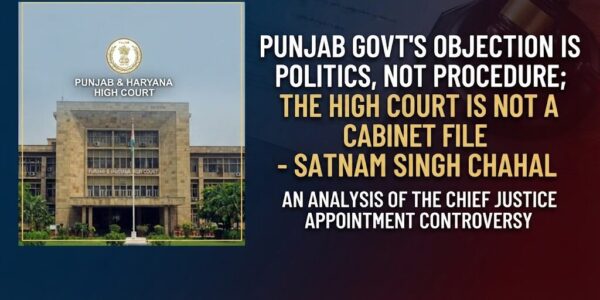
Punjab Chief Minister Bhagwant Mann has framed the appointment of Justice Ashwani Kumar Mishra as Chief Justice of the Punjab and Haryana High Court as another “assault” on the State’s rights. After an emergency Cabinet meeting, he said the Centre notified the elevation without the State government’s consent, called this a violation of the Memorandum of Procedure and constitutional norms, and asked that the oath be withheld until Punjab’s views are obtained and considered. His ministers have gone further, describing the episode as an insult to the elected government and to three crore Punjabis. That language is politically powerful. It is also legally overstated. The Supreme Court Collegium recommended Justice Mishra on 6 August 2026. He had already been Acting Chief Justice since June.
The Governor and the Union Law Minister sought the State’s views on 12 August. The Centre notified the appointment on 5 September. Mann complains that Punjab had not yet replied, and that Paragraph 6 of the MoP required those views before the file moved to the President. That is a point about timing. It is not a point that the Chief Minister holds a veto. The Collegium process does not begin in the Punjab Secretariat. For a High Court Chief Justice, the proposal is initiated by the Chief Justice of India, in consultation with the two senior-most judges of the Supreme Court and the senior-most Supreme Court judge familiar with the High Court concerned. Only after that judicial recommendation reaches the Union Law Minister does the MoP require the Centre to obtain the views of the State government. Those views are then placed before the Prime Minister. Consultation is mandatory. Consent is not. Article 217 speaks of consultation with the Governor, not approval by the Cabinet.
After the Second and Third Judges Cases, the Collegium’s reiterated recommendation binds the executive. A State government may comment; it may not hold the warrant hostage.Mann’s statement converts that consultative step into a claim of co-equal power. If every Chief Minister can stall a High Court Chief Justice by not sending comments, judicial appointments become another arena of Centre–State bargaining. That is precisely what the Collegium system was designed to prevent. The independence of the High Court does not depend on whether the government of the day likes the name. It depends on whether the executive can delay, condition or politicise the oath.There is a narrower process argument that deserves a straight answer. The broader MoP practice for High Court appointments gives the State a window often described as six weeks after which silence may be treated as no objection. From 12 August to 5 September is less than that full window. If Punjab’s only demand had been a few more days to send a reasoned note, the controversy would have been administrative.
That is not what the Cabinet resolution says. It asks that appointment and swearing-in be kept on hold until the State’s views are not merely received but “duly considered,” and it ties the judicial file to unrelated disputes over RDF dues, flood relief and the Bhakra Beas Management Board. Once a judicial appointment is folded into a list of political grievances, the objection is no longer about consultation. It is about leverage.Justice Mishra’s suitability was a matter for the Collegium. Seniority debates, if any, belonged there, not in a Sunday Cabinet meeting. The High Court Bar Association’s criticism of the State’s stand is a reminder that the legal community sees the risk clearly: an elected executive questioning a Collegium-backed Chief Justice, after the notification has issued, looks like an attempt to influence the court that will hear cases against that same government.
Federalism is not protected by turning the High Court into a negotiated settlement. Punjab’s government is entitled to send its views, on time, in writing, on the limited grounds the MoP contemplates integrity, antecedents, local considerations. It is not entitled to declare that there can be no Chief Justice until the Chief Minister agrees. Mann’s statement should be read against that line. The concerning part is not that a State wants to be heard. The concerning part is the claim that hearing the State means the court must wait on political consent. That claim undermines the separation of powers, and it should be rejected.
Disclaimer: This article and accompanying images are for informational and illustrative purposes only. Some visuals may be AI-generated or digitally enhanced and may not depict actual events or persons.Views expressed are based on publicly available information and analysis